
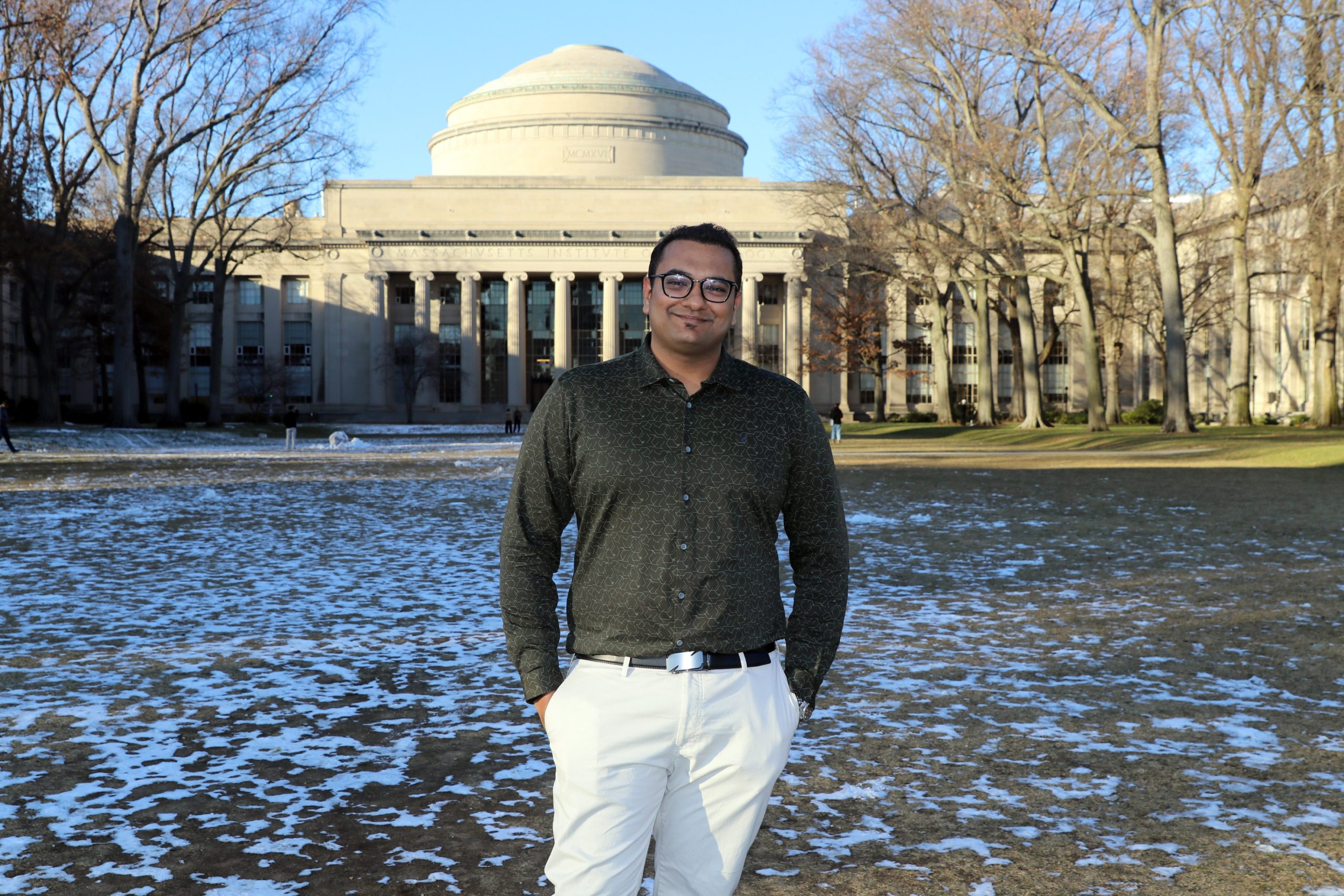
“Congratulations! We are pleased to inform you that you have been accepted to…”
Imagine reading these lines in your decision letter from MIT. I only read the sentence up to “accepted,” then I blacked out. When I regained my senses, I re-read the letter out of sheer disbelief about 30 seconds later with my phone pressed to my ear, and my family on the other side.
MIT has changed my life – no doubt about that.
Growing up on the streets of New Delhi – or in any city that feels impossibly far away from Cambridge, Massachusetts – you don’t really think one day you’ll apply to MIT, let alone walk its campus. But here I am. You can be too.
For the record, I was a backbencher all my life. Middle of the pack. What worked for me wasn’t brilliance – it was motivation, consistency, and one powerful realisation: it’s never too late.
Rule #1 – It’s never too late to start being consistent.
1% effort for 100 days in a row will make you 3 times better than you are today. (1.01^100=2.7)
After a string of B grades throughout middle and high school, I hit my lowest point during the practice finals in my senior year. I scored 40/100 in math. Shocking, right?
That day, my teacher called me in and said, “Utkarsh, there are 100 days left for your final exams. At this pace, you will not go to college.” It sounded harsh. But it was the truth. What followed was consistency. 100 days of it.
The outcome? I ranked first in my high school in the final exams. If 100 days of consistency could take me from a 40 to a 95, imagine what it can do over the years. The feeling of having my parents in the audience when I received the award was unparalleled.
Rule #2 – Try everything to figure out your priorities, then commit.
As our Economics professor at MIT, Professor Charles, likes to say: “Sunk cost fallacy is real. Don’t fall for it. Cut your losses and run.”
During undergrad, I thought I was doing what I loved. I was a gearhead, studying automobile engineering and building cars on the side – what more could you want? But I quickly realized something uncomfortable: I needed to separate my hobby from my passion.
Frankly, I wasn’t great at engineering. Humans love many things from afar. Doing them every day is a different story. So, I tried everything.
I experimented. I pivoted. I doubled down on my strengths. That made all the difference: I got a 9 GPA in my last 4 semesters and eventually aced my job interviews.
Don’t be afraid to try new things, or to walk away from them.
Rule #3 – Never give up.
Don’t let the number of times you have failed in the past determine the number of times you try in the future.
Fast forward a few years, and I have since graduated from college. Now my ambitious self is struggling with the GMAT. Three attempts in, I’m exhausted and broke. I somehow gather the courage to try a fourth attempt. Another poor score.
This time, I’m shattered.
I catch myself convincing my heart that my life is already great. I have a stable job, a decent apartment, a nice car.
What’s missing? Nothing. What’s special? Also nothing.
But that’s how the human mind works. From an outside perspective, I had accomplished a lot: I managed a spend of $300M at the age of 23 and successfully launched 5G in India with Bharti Airtel. Now, I was managing more than $1B worth of inventory for the most complex machines on the planet in my role at United Airlines. But I still felt that there was this one ‘special’ thing missing.
This is what scared me the most: In my five years of professional experience, every person I met walked away believing one thing about me – that I would do great things in life. Giving up on the dream of attending MIT meant disappointing myself.
I used that fear as leverage and gave the GMAT one last shot. Et voila.
If you have managed to read this far down, here’s a small bonus nugget. The time between receiving your admittance and your first day on campus – basically the journey from reading “Massachusetts” to being able to spell it – will be one of the most exciting phases of your life. But it will not prepare you for what’s to come. Nothing will.
So, as far as life at MIT goes, I hope every reader who dreams of attending MIT (like I did) gets to experience it someday. Keep believing. Follow the three rules. Get in. Then write your own article challenging them.
I always love a challenge.
Cheers and all the best,
Utkarsh Goel (UT)
Utkarsh (UT) Goel is a graduate candidate in MIT’s Supply Chain Management Master’s program. UT has a background in Supply Chain Management with experience across the Telecom and Aviation sectors, most recently at United Airlines. Over the years, he has worked across key areas such as procurement, inventory planning, and vendor management, building a strong foundation in end-to-end supply chain operations.