Whenever I tell people I’m from Egypt, I usually get two questions: “How were the Pyramids built?” or “Have you ever ridden a camel to work?” My answers are usually: “Excellent engineering, disciplined project leadership and remarkable supply chain management” and “No, not to work and only once, but in Cairo traffic, it would be a massive upgrade in transit lead-time reliability.”
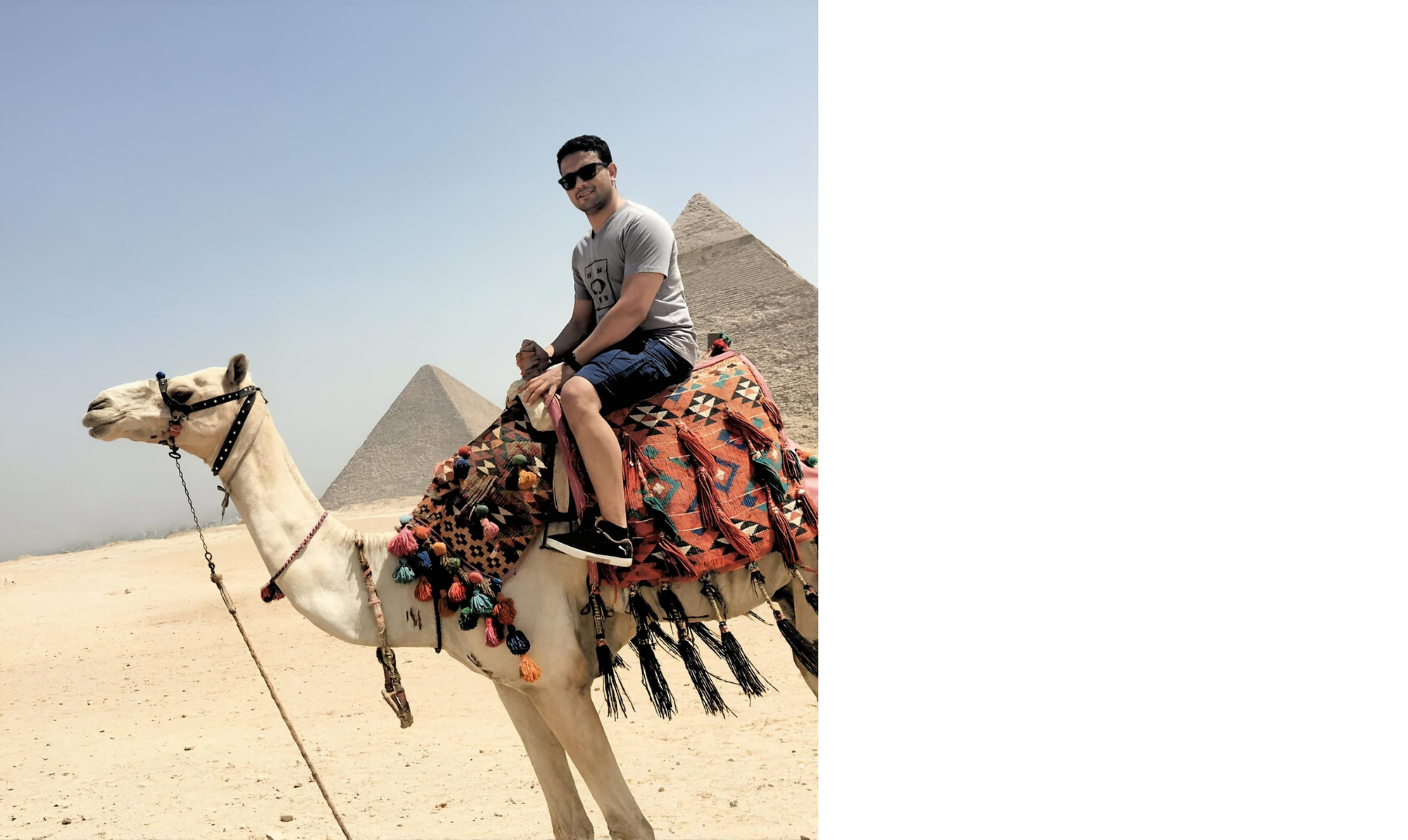
Here is a picture of me riding a camel 🙂
But my journey to the MIT Supply Chain Management (SCM) program wasn’t a direct flight from the Nile to the Charles River. It was a path that took me from an undergraduate engineering degree in Egypt to a career in the United States, navigating the intersection of engineering and program and project management and a curiosity that led me to MIT.
The “Safety Stock” of the Soul
I used to look at the Pyramids and think only about the engineering and project management skills it took to build them. Now I also think about the logistical feat it required. Imagine being the ancient supply chain lead for Khufu. There is no RFID to track, no Excel or Gurobi to optimize, and if your “Just-in-Time” delivery of limestone blocks is “Just-too-Late”, you have more to worry about than just losing your bonus!
I carried that “builder” mindset with me when I moved to the U.S. Over multiple engagements, I had my focus fixed on engineering excellence, delivery discipline, and construction milestones. And for a long time, I viewed supply chain as something separate that happens in the background in response to project needs, but as projects grew in scale and Covid happened, my world was becoming entirely supply chain driven.
I realized that to truly de-risk projects, I needed to see deeper. I didn’t just want a promised delivery date backed by liquidated damages and penalties; I wanted to understand the full supply chain ecosystem. I started to ask questions like: What were the true cost drivers behind each component and sub-component? How can we help the different tier suppliers to optimize and become more efficient to ensure profitability and reliability across the network? Did the sub-suppliers have the capacity to handle the next wave of deployments? And as sustainability became a core requirement, how could we track the environmental footprint of a component three steps removed from the job site? The list kept growing.
I was hitting the limits of traditional visibility where data was siloed, often protected, and the deeper layers of the supply chain remained a “black box.” It was the modern equivalent of an ancient architect knowing his site was ready, but having no way to verify the health of the quarry a hundred miles up the Nile.
That curiosity is what led me to the MITx MicroMasters and eventually to the SCM Master’s program. Every student who arrives at MIT quickly learns the reality of “drinking from the fire hose”: just when you think you have enough, you discover there’s more. Yet the value of MIT and SCM goes beyond the rigor of the curriculum; it’s in the unparalleled access it provides to the architects of global supply chain.
Access Beyond the Classroom: Strategy at the Source
During the SCM Panama study trek, my classmates and I had the opportunity to meet with Alberto Alemán Zubieta, the former Administrator of the Panama Canal Authority (ACP). Attending a presentation from the man who ensured a smooth transition of the canal to the Panamanian administration and was the visionary behind the historic expansion of the canal was a full-circle moment for me.
I had the chance to discuss geopolitical strategy with him, specifically how the canal accommodates the massive flow increases caused by current global events and shifts in maritime routes. We talked about how the canal authority thinks like a business, developing a competitive strategy to attract new markets and shippers in an increasingly volatile world. (And for the record: No, I wasn’t trying to figure out what the Panama Canal Authority is doing to attract new markets away from the Suez Canal).
Such an opportunity is available to only a few, and MIT SCM made my classmates and me part of that group. Engaging with a leader like Alemán Zubieta allowed me to see the frameworks and topics we study in SCM in action at a global scale. It reminded me that whether you are managing the Suez, the Panama Canal, or a global infrastructure rollout, your objective remains the same: to create the most resilient, cost-effective, and sustainable networks for your customers, regardless of how volatile the global landscape becomes.
Trading the Chisel for the MIT Scalpel
I didn’t come to MIT to learn how to work harder – trust me, I know how to do that! I came for the analytical toolkit provided by the SCM curriculum, the depth of resources it provides and the wisdom of practitioners who have actually moved the needle on a global scale.
Whether through optimization models or digital frameworks, I am trading my physical chisel for an analytical scalpel. We are still building monuments; only now, we build them out of code, frameworks, and transparent, data-driven networks. The program has taught me that the “Great Pyramids” of the modern world aren’t made of stone; they are the invisible, interconnected webs of fulfillment that keep the world running. I’m still a builder at heart and a lifelong curious learner who believes that almost anything is achievable if you explore it deeply enough. If you’re considering the SCM program, bring your curiosity with you; it will take you further here than any perfect plan ever could.
Ahmed Abdelhak is a Program Manager with over a decade of experience leading large-scale technology and infrastructure initiatives, shaping supply chain strategy and operational execution within complex technical environments. His background includes driving EPC-led infrastructure builds, scaling new product introductions (NPI), and delivering mission-critical technology deployments across material handling and logistics, pharmaceutical, and, in recent years, hyperscale data center industries. Prior to MIT, he led multi-region programs, translating strategy into coordinated execution across distributed, cross-functional teams and vendors (OEMs, ODMs, and CMs), as well as deployment partners.